
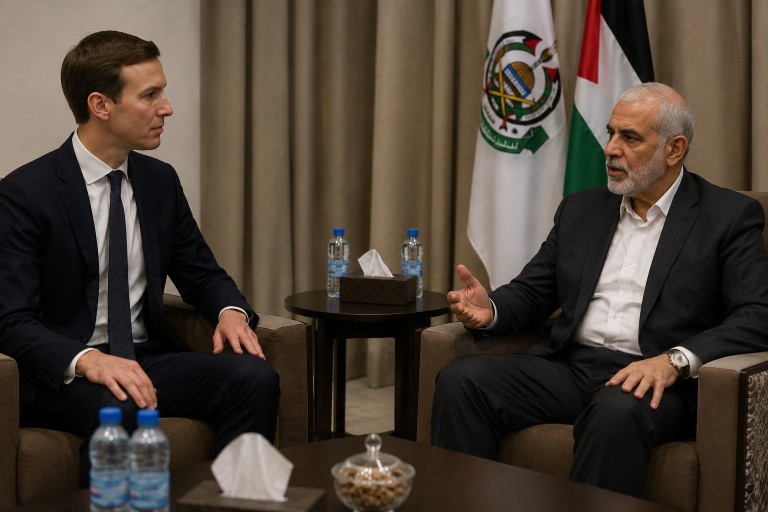
In a renewed effort to address the stalled Gaza ceasefire plan, Jared Kushner, the United States envoy and son-in-law of former President Donald Trump, held a notable meeting with Khalil al-Hayya, the political chief of Hamas, in Egypt on Sunday. This interaction precedes Kushner’s scheduled discussions with Israeli Prime Minister Benjamin Netanyahu, who has recently rebuffed a U.S.-endorsed 15-point proposal aimed at advancing the ceasefire’s next phase.
The ceasefire proposal suggests a phased disarmament of Hamas, while expecting Israel to cease military actions and withdraw from designated zones within Gaza. Additionally, the plan envisions reconstruction efforts and the deployment of international forces to ensure security. While Hamas has expressed a willingness to adhere to the road map, it insists on Israel halting its attacks and retreating to a predetermined “yellow line” before any action is taken. Furthermore, Hamas has linked the surrendering of its heavier weaponry to tangible progress toward establishing a Palestinian state, a notion strongly opposed by Netanyahu’s administration.
Netanyahu remains firm on the stance that a full withdrawal of Israeli forces from Gaza is contingent upon the complete disarmament of Hamas. This impasse has delayed key elements of the ceasefire, including reconstruction initiatives and the deployment of international peacekeeping forces. Kushner’s meeting with Hamas also included representatives from Egypt, Qatar, and Turkey, focusing on gaining Hamas’s commitment to disarmament as part of the broader ceasefire framework.
Alongside these diplomatic efforts, Kushner is expected to engage in further discussions with Netanyahu, in which former British Prime Minister Tony Blair and Nickolay Mladenov, director of the Board of Peace, will also participate. Meanwhile, the rejection of the U.S.-backed road map by Israel has drawn criticism from several regional powers, including Saudi Arabia, the United Arab Emirates, Jordan, Pakistan, and Indonesia, all of which have called for immediate action to avoid further delays.
This heightened diplomatic activity occurs as Netanyahu grapples with domestic political pressures ahead of Israel’s forthcoming election in October. His government coalition includes ministers favoring a more aggressive approach to the Gaza situation, casting uncertainty over the ceasefire plan’s future and further complicating the path to peace in the region.